3D printed face shields: Difference between revisions
Alikureishy (talk | contribs) No edit summary |
|||
| (134 intermediate revisions by 7 users not shown) | |||
| Line 1: | Line 1: | ||
[[File: | [[File:Doctor Sanjay Kurani of VMC 2.JPG|200px|thumb|Dr. Sanjay Kurani of VMC with Maker Nexus face shield]] | ||
[[File:Regional_Medical_Center_San_Jose_-_Becka_Webber.JPG|thumb|200px|Regional Medical Center San Jose with MN face shields]] | |||
Face shields are used by health care professionals to protect them when working with patients. Hospital supplies were running low. While they prefer to use commercially manufactured ones, in this emergency they were looking for alternative sources. | |||
Visit [http://covidshieldnexus.org COVID Shield Nexus] for additional information on the overall program. | |||
== Overview == | == Overview == | ||
Face shields are | [[File:Face shield front.jpg|200px|thumb|right|Front View]] [[File:Face shield side.jpg|200px|thumb|right|Side View]] [[File:Face shield top.jpg|200px|thumb|right|Top View showing wrap over]] | ||
Maker Nexus has wrapped up our efforts on this project. With the help of over 600 volunteers around the country (and Canada) we have made and given away over 80,000 face shields. We also partnered with a local philanthropic company to make and give away 170,000 more. Over 250,000 face shields in total from this project! Other groups are still working on face shields. If you want to get involved you should contact them. | |||
* [https://local.masksfordocs.com/us-ca-scsouth Masks For Docs] | |||
* [https://getusppe.org/ Get Us PPE] | |||
The headband portion of these shields is made on a 3D printer. If you have a 3D printer, you can make these. We delivered them to local hospitals. | |||
'''In the News''' | |||
* A mini documentary [https://www.nbcbayarea.com/news/coronavirus/museum-and-maker-space-design-safety-gear-for-bay-area-hospitals/2302179/ about MN and The Exploratorium] | |||
* A TV segment [https://sanfrancisco.cbslocal.com/video/4495791-maker-community-uses-3-d-printer-to-supply-ppe-to-health-professionals/ from KPIX] | |||
* Watch a short [https://www.ktvu.com/news/covid-19-sunnyvale-company-designing-3d-protective-masks-to-meet-demand KTVU news report about our efforts.] | |||
* A blog by [https://medium.com/@prithvisathiya/fighting-covid-19-2071e8b00b4c one of our community print team] talking about his experience. | |||
[ | [https://drive.google.com/drive/u/1/folders/1ctRiSGibdSyNa39tAXY4sKIrBgyTjnSg Our press kit] | ||
'''How much do they cost?''' | |||
We gave these away, paying for them from donations. We did not sell them. Promises of donations or actual donations did not affect who was prioritized to receive the PPE. The allocation team was not told who has donated. However, they cost us about $5 each to make. Donations were critical for us to be able to keep producing. We were pleased that so many donated to support the effort. | |||
| | ||
'''Was there really a need?''' | |||
* We | * We heard from friends that "nurses are cutting up plastic soda bottles to make face shields, using saran wrap on top of N95 masks to allow for multi-use." | ||
* One local nurse said they are making face shields from cut up shower curtains and hot glue guns. | * One local nurse said they are making face shields from cut up shower curtains and hot glue guns. | ||
* In reviewing the current design: "The nurses were over the moon about how easily the shields can be disassembled and sterilized." | |||
* A nurse from Marin called us and I got her hooked into the allocation process and told her they were free. She started crying on the phone. - JimS | |||
Some photos of [https://www.covidshieldnexus.org/front-line-heroes front line workers with Maker Nexus face shields]. | |||
See [[Face Shield User Stories|stories from those who have received face shields from us]]. | |||
'''How do I get some?''' | |||
We stopped our efforts because there are now shields available from many retail outlets. Do a web search on "face shields". | |||
If you need them for free, you could contact one of the following organizations: | |||
* [https://getusppe.org/ Get Us PPE] | |||
* [https://masksfordocs.com/ Masks For Docs] | |||
A link to [[MN COVID Response|Other COVID Projects]] | |||
==== | == 3D Print Parts At Home == | ||
=== | === Use Your 3D Printer for good === | ||
'''Maker Nexus has ended this project.''' We appreciate all the work the distributed team has done. With your help we have been able to make and give away over 250,000 face shields across the US. | |||
== 3D Print Directions == | == 3D Print Directions == | ||
| Line 57: | Line 63: | ||
'''Filament''' | |||
These face shields are best done with PETG filament. A 1kg spool can make about 20 units. | These face shields are best done with PETG filament. A 1kg spool can make about 20 units. They can be done with PLA but it is difficult to get them strong enough to handle all the bending. | ||
The face shield stiffener at the bottom of the plastic shield can be printed in PLA. A 1kg spool can make about 180 units. | |||
=== Instructions === | === Instructions === | ||
'''Printer Settings''' | |||
Print with PETG for ease of sanitation - IPA, Hydrogen Peroxide, Bleach, and Acetic Acid up to 10% can all be safely used with PETG. | Print with '''PETG''' for ease of sanitation - IPA, Hydrogen Peroxide, Bleach, and Acetic Acid up to 10% can all be safely used with PETG. | ||
If you don't have PETG, using '''ABS''' and '''PLA''' is also an approved option. | |||
Print settings: | Print settings: | ||
| Line 86: | Line 84: | ||
=== Parts === | === Parts === | ||
We are | We use a modified Prusa design. Our headbands maintain compatibility with the placement of the pins to mount the shield. After consultation with two local hospital teams, we made several changes to the original Prusa design. | ||
* The shield mounting pins are moved up to the middle of the headband to eliminate a potential entry point for aerosols. When the shield is mounted to lower pins the hole in the shield is not completely covered by the headband. | |||
* The flex points between the headband and the "wings" have a radius added. This makes it easier to clean. The original design had a narrow angle in that area. | |||
* The headband is made narrower to print faster. We find that using PETG these headbands are very strong. | |||
* The shield has an over-the-top dome that protects against droplets falling down onto the face. | |||
Our design is, of course, released back to the world under the same CC licensing as the original. Links to our design files are on this page. | |||
==== What to print now ==== | |||
Please do not print additional parts for us. | |||
==== | ==== Historic ==== | ||
''Files for the parts we used to make our face shields'' | |||
Bottom Stiffeners | |||
[[File:prusa-bottom-part-plate.png|right]] | |||
On one build-plate of a Prusa, we are able to fit 34 (might be a little bit more with more squeezing); it takes a little bit more than 8 hours, which is great for night-shifts, as there is no lost time. This also means that in optimal situations, we can get around 100 per day per printer. | |||
GCode: | |||
* [https://github.com/makernexus/prusa-covid19-shield-remix/raw/master/fab/bottoms-PETG-Prusa.gcode bottoms-PETG-Prusa.gcode] '''PETG''' for Prusa MK3s | |||
* [https://github.com/makernexus/prusa-covid19-shield-remix/raw/master/fab/bottoms-PLA-Prusa.gcode bottoms-PLA-Prusa.gcode] '''PETG''' for Prusa MK3s | |||
* [https://github.com/makernexus/prusa-covid19-shield-remix/raw/master/plate-full-of-bottom-supports.3mf plate-full-of-bottom-supports.3mf] '''3mf''' Project file for prusa-slicer | |||
* [https://github.com/makernexus/prusa-covid19-shield-remix/raw/master/fab/bottom_reinforcement.stl bottom_reinfocement.stl] '''STL''' do manually fill your build-plate and slice. | |||
Head bands | |||
Most important change in our headband design is that the pins are centered in the headband, so that there is something covering the shield punch, making a better seal. Also, the radii in the crevices are larger than the original to facilitate easier sanitation. | |||
Latest release is v1.9 (2020-04-06) | |||
This archive contains (next to the source files) the following files used used to print, which you also can download here: | |||
* '''Ready-to-go GCode''': [https://github.com/makernexus/prusa-covid19-shield-remix/raw/v1.9/fab/T9-PETG-Prusa.gcode T9-PETG-Prusa.gcode] (right click, download or ''save link as...'') for '''PETG''', [https://github.com/makernexus/prusa-covid19-shield-remix/raw/v1.9/fab/T9-PLA-Prusa.gcode T9-PLA-Prusa.gcode] for '''PLA'''. This prints two headbands and two bottom stabilizers. Using print-speed of 130% on the Prusa seems to work fine. If you use '''ABS''', please use the files below to slice for your printer. These print with little 'D-shaped' supports in front of the pins, that should break off easily. | |||
* '''3MF slicer project file''' [https://github.com/makernexus/prusa-covid19-shield-remix/raw/v1.9/thin_shield.3mf thin_shield.3mf] for PETG and [https://github.com/makernexus/prusa-covid19-shield-remix/raw/v1.9/thin_pla_shield.3mf thin_pla_shield.3mf] for PLA. This allows you to choose placement, temperatures, select which parts to print on the bed etc. | |||
* '''slice yourself''' [https://github.com/makernexus/prusa-covid19-shield-remix/raw/v1.9/fab/thin_shield_with_support.stl thin_shield_with_support.stl] (right click, download or ''save link as...'') for PETG, [https://github.com/makernexus/prusa-covid19-shield-remix/raw/v1.9/fab/thin_pla_shield_with_support.stl thin_pla_shield_with_support.stl] for PLA. There is also a no-support stl version in case you want to add support for the front-pins yourself in your slicer. If you _do_ print with build-in supports, make sure to enable the ''''Detect Thin Walls'''' feature in your slicer. | |||
Also please print one [https://github.com/makernexus/prusa-covid19-shield-remix/raw/master/fab/bottom_reinforcement.stl bottom_reinforcement.stl] per headband (sometimes it is more efficient to do that separately). If you slice the version with built-in support, make sure to have 'enable thin wall detection' in your slicer. The 3mf files already have that enabled. | |||
If your printer can't fit a headband, you can still help and print the bottom parts, stabilizing the shield plastic: Print as many [https://github.com/makernexus/prusa-covid19-shield-remix/raw/master/baseline/bottom_reinforcement.stl bottom_reinforcement.stl] that you fit on your print-bed: we need them as many people with larger print-beds focus on the headbands itself right now. | |||
Here is a [https://github.com/makernexus/prusa-covid19-shield-remix/raw/master/plate-full-of-bottom-supports.3mf plate-full-of-bottom-supports.3mf] file to load directly into a slicer. Sometimes it is | |||
a good idea to use the night-time shift to print these. | |||
More files, 3mf and STL you get directly on Github: https://github.com/makernexus/prusa-covid19-shield-remix#cut-to-the-chase-gcode-ready-to-use | |||
== Laser Cut Parts == | == Laser Cut Parts == | ||
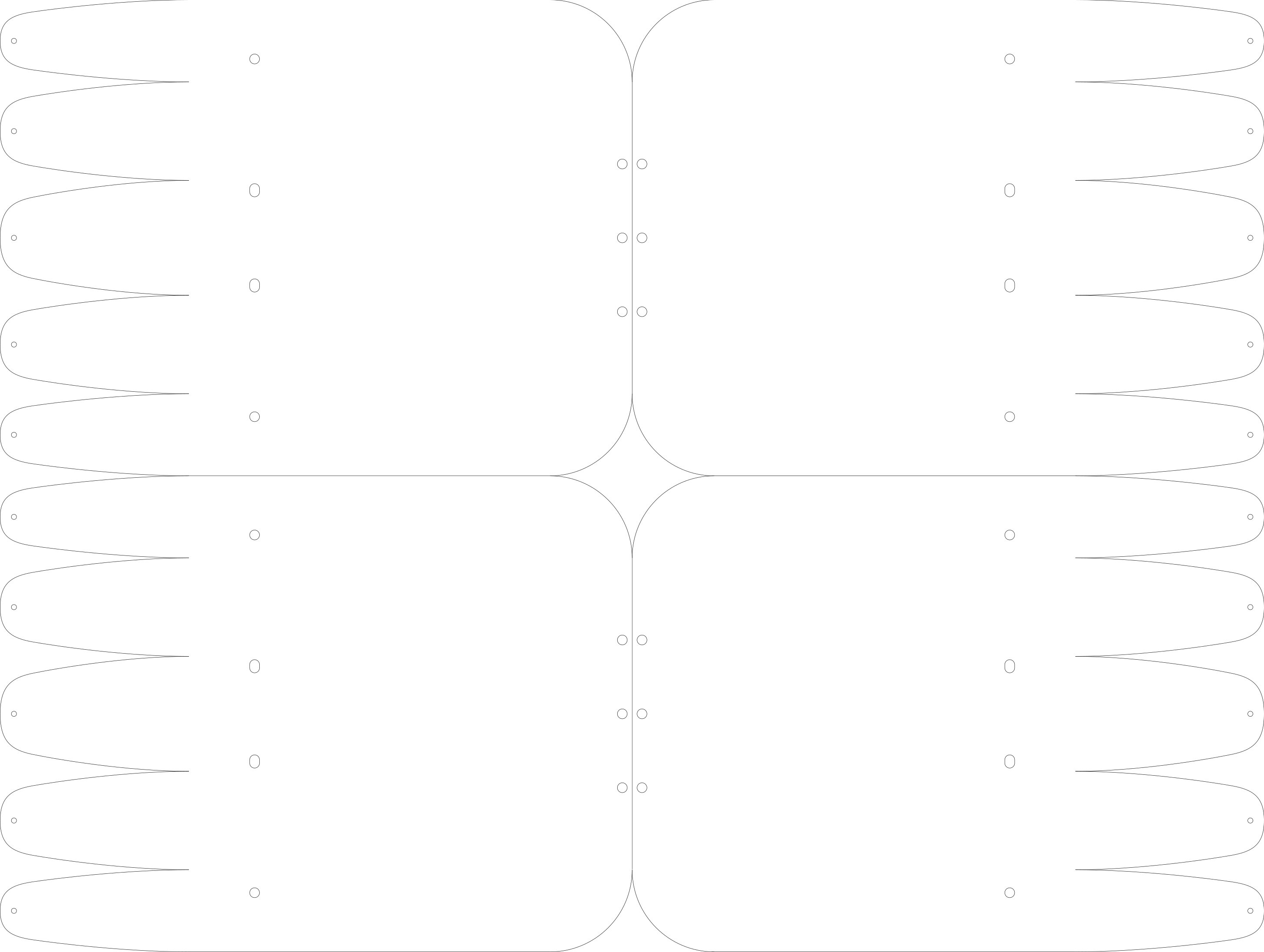
* [[:media: | * [[:media:Wrapover-faceshield-laser.svg|The SVG file for laser cutting the shield part]] SVG File | ||
* [[:media:X4 020PETG raw.svg|The SVG file but 4 at a time]]. | |||
The shields are cut from 0.020 inch thick PETG sheets. Our base design fits into sheets of 24"x32". If we get donations of larger sheets, then we cut it down before using it. | The shields are cut from 0.020 inch thick PETG sheets. We have successfully used 0.030, it is more expensive. 0.040 is too thick and will not snap onto the headband. | ||
'''PETG Sheet''' | |||
One 4x8 foot sheet can make 24 shields. Our base design fits into sheets of 24"x32". If we get donations of larger sheets, then we cut it down before using it. Sheets come in different thicknesses. | |||
* .020 inch CLR VIVAK PETG JFM is the best. This typically comes with a protective skin on each side. | |||
* .015 inch PETG can be used. It often comes without the protective skins, so you will have laser cutter residue on the shield. | |||
* .030 inch PETG can be used with 3D printed headbands. However, for injection molded parts the shield holes have to be modified slightly or the shield will pull too flat. | |||
We believe both APET and RPET can also be used. | |||
== Elastic Band == | == Elastic Band == | ||
| Line 116: | Line 157: | ||
* [https://www.homesew.com/ Home Sew] | * [https://www.homesew.com/ Home Sew] | ||
== Assembly == | == Assembly and Disassembly == | ||
Each box of face shields contains a QR Code that links to [[Covid-19 Shield User Instructions]] | |||
'''Assembly''' | |||
Assembly requires about 8" of 3/4 wide button hole elastic. | Assembly requires about 8" of 3/4 wide button hole elastic. | ||
* [https:// | * A short video on [https://youtu.be/qKqDUExM4Q8 how to assemble the Maker Nexus face shield version RC2] | ||
* A nice graphic [https://www.covidshieldnexus.org/faceshieldassembly on assembly] also here [[media:Faceshieldassembly_v01.pdf|PDF]] | |||
'''Disassembly for cleaning''' | |||
These face shields can be taken apart for cleaning. | |||
You | The sheets are made of PETG and can handle alcohol and UV. The head band and spreader could be made of PETG, ABS, or PLA. These all resist alcohol but are heat sensitive. We are not experts in how to sanitize equipment. You, as user, take responsibility for appropriate sanitization. See [https://help.prusa3d.com/en/article/prusa-face-shield-disinfection_125457#_ga=2.91675610.133084680.1585293016-139199844.1585293016 this page from Prusa Research] for information on sanitization methods currently being tested. | ||
A short video on [https://www.youtube.com/watch?v=F7FFPzGeRME how to take the Maker Nexus face shield apart] | |||
== External Links == | == External Links == | ||
| Line 143: | Line 183: | ||
== | == Other Alternatives == | ||
We sincerely hope that all health care workers get the PPE that they need. However, in some parts of the world this may not happen. We believe the design we are using is the best for our team to make. There are, however, other solutions and we will list some here. | |||
* [https://twitter.com/sanjayjaindc/status/1247883812249296898 Low end] for complete emergency use. Tape, sticks, and a sheet protector. | |||
* | * [https://3dprint.nih.gov/discover/face-shield NIH exchange] has a number of different designs | ||
* | * The original design [https://www.prusaprinters.org/prints/25857-prusa-protective-face-shield-rc2 Prusa RC2 STL- On this page] | ||
* [https://www.notion.so/Open-Source-Face-Shield-c7ebd84f2dbe4be5ab0974c85c49d9ff A design using only a laser cutter] | |||
Latest revision as of 23:54, 29 January 2021


Face shields are used by health care professionals to protect them when working with patients. Hospital supplies were running low. While they prefer to use commercially manufactured ones, in this emergency they were looking for alternative sources.
Visit COVID Shield Nexus for additional information on the overall program.
Overview


Maker Nexus has wrapped up our efforts on this project. With the help of over 600 volunteers around the country (and Canada) we have made and given away over 80,000 face shields. We also partnered with a local philanthropic company to make and give away 170,000 more. Over 250,000 face shields in total from this project! Other groups are still working on face shields. If you want to get involved you should contact them.
The headband portion of these shields is made on a 3D printer. If you have a 3D printer, you can make these. We delivered them to local hospitals.
In the News
- A mini documentary about MN and The Exploratorium
- A TV segment from KPIX
- Watch a short KTVU news report about our efforts.
- A blog by one of our community print team talking about his experience.
How much do they cost?
We gave these away, paying for them from donations. We did not sell them. Promises of donations or actual donations did not affect who was prioritized to receive the PPE. The allocation team was not told who has donated. However, they cost us about $5 each to make. Donations were critical for us to be able to keep producing. We were pleased that so many donated to support the effort. Was there really a need?
- We heard from friends that "nurses are cutting up plastic soda bottles to make face shields, using saran wrap on top of N95 masks to allow for multi-use."
- One local nurse said they are making face shields from cut up shower curtains and hot glue guns.
- In reviewing the current design: "The nurses were over the moon about how easily the shields can be disassembled and sterilized."
- A nurse from Marin called us and I got her hooked into the allocation process and told her they were free. She started crying on the phone. - JimS
Some photos of front line workers with Maker Nexus face shields.
See stories from those who have received face shields from us.
How do I get some?
We stopped our efforts because there are now shields available from many retail outlets. Do a web search on "face shields".
If you need them for free, you could contact one of the following organizations:
A link to Other COVID Projects
3D Print Parts At Home
Use Your 3D Printer for good
Maker Nexus has ended this project. We appreciate all the work the distributed team has done. With your help we have been able to make and give away over 250,000 face shields across the US.
3D Print Directions
Materials
Filament
These face shields are best done with PETG filament. A 1kg spool can make about 20 units. They can be done with PLA but it is difficult to get them strong enough to handle all the bending.
The face shield stiffener at the bottom of the plastic shield can be printed in PLA. A 1kg spool can make about 180 units.
Instructions
Printer Settings
Print with PETG for ease of sanitation - IPA, Hydrogen Peroxide, Bleach, and Acetic Acid up to 10% can all be safely used with PETG. If you don't have PETG, using ABS and PLA is also an approved option.
Print settings:
- Temperature based on filament selection.
- 3 perimeters
- 100% infill
- 0.3mm Draft settings in PrusaSlicer work fine
- we are running our Prusa's at 130% speed
Parts
We use a modified Prusa design. Our headbands maintain compatibility with the placement of the pins to mount the shield. After consultation with two local hospital teams, we made several changes to the original Prusa design.
- The shield mounting pins are moved up to the middle of the headband to eliminate a potential entry point for aerosols. When the shield is mounted to lower pins the hole in the shield is not completely covered by the headband.
- The flex points between the headband and the "wings" have a radius added. This makes it easier to clean. The original design had a narrow angle in that area.
- The headband is made narrower to print faster. We find that using PETG these headbands are very strong.
- The shield has an over-the-top dome that protects against droplets falling down onto the face.
Our design is, of course, released back to the world under the same CC licensing as the original. Links to our design files are on this page.
What to print now
Please do not print additional parts for us.
Historic
Files for the parts we used to make our face shields
Bottom Stiffeners

On one build-plate of a Prusa, we are able to fit 34 (might be a little bit more with more squeezing); it takes a little bit more than 8 hours, which is great for night-shifts, as there is no lost time. This also means that in optimal situations, we can get around 100 per day per printer.
GCode:
- bottoms-PETG-Prusa.gcode PETG for Prusa MK3s
- bottoms-PLA-Prusa.gcode PETG for Prusa MK3s
- plate-full-of-bottom-supports.3mf 3mf Project file for prusa-slicer
- bottom_reinfocement.stl STL do manually fill your build-plate and slice.
Head bands
Most important change in our headband design is that the pins are centered in the headband, so that there is something covering the shield punch, making a better seal. Also, the radii in the crevices are larger than the original to facilitate easier sanitation.
Latest release is v1.9 (2020-04-06)
This archive contains (next to the source files) the following files used used to print, which you also can download here:
- Ready-to-go GCode: T9-PETG-Prusa.gcode (right click, download or save link as...) for PETG, T9-PLA-Prusa.gcode for PLA. This prints two headbands and two bottom stabilizers. Using print-speed of 130% on the Prusa seems to work fine. If you use ABS, please use the files below to slice for your printer. These print with little 'D-shaped' supports in front of the pins, that should break off easily.
- 3MF slicer project file thin_shield.3mf for PETG and thin_pla_shield.3mf for PLA. This allows you to choose placement, temperatures, select which parts to print on the bed etc.
- slice yourself thin_shield_with_support.stl (right click, download or save link as...) for PETG, thin_pla_shield_with_support.stl for PLA. There is also a no-support stl version in case you want to add support for the front-pins yourself in your slicer. If you _do_ print with build-in supports, make sure to enable the 'Detect Thin Walls' feature in your slicer.
Also please print one bottom_reinforcement.stl per headband (sometimes it is more efficient to do that separately). If you slice the version with built-in support, make sure to have 'enable thin wall detection' in your slicer. The 3mf files already have that enabled.
If your printer can't fit a headband, you can still help and print the bottom parts, stabilizing the shield plastic: Print as many bottom_reinforcement.stl that you fit on your print-bed: we need them as many people with larger print-beds focus on the headbands itself right now. Here is a plate-full-of-bottom-supports.3mf file to load directly into a slicer. Sometimes it is a good idea to use the night-time shift to print these.
More files, 3mf and STL you get directly on Github: https://github.com/makernexus/prusa-covid19-shield-remix#cut-to-the-chase-gcode-ready-to-use
Laser Cut Parts
The shields are cut from 0.020 inch thick PETG sheets. We have successfully used 0.030, it is more expensive. 0.040 is too thick and will not snap onto the headband.
PETG Sheet
One 4x8 foot sheet can make 24 shields. Our base design fits into sheets of 24"x32". If we get donations of larger sheets, then we cut it down before using it. Sheets come in different thicknesses.
- .020 inch CLR VIVAK PETG JFM is the best. This typically comes with a protective skin on each side.
- .015 inch PETG can be used. It often comes without the protective skins, so you will have laser cutter residue on the shield.
- .030 inch PETG can be used with 3D printed headbands. However, for injection molded parts the shield holes have to be modified slightly or the shield will pull too flat.
We believe both APET and RPET can also be used.
Elastic Band
Each shield uses approximately 8 inches of button hole elastic, 3/4 inch wide.
Sources
Assembly and Disassembly
Each box of face shields contains a QR Code that links to Covid-19 Shield User Instructions
Assembly
Assembly requires about 8" of 3/4 wide button hole elastic.
- A short video on how to assemble the Maker Nexus face shield version RC2
- A nice graphic on assembly also here PDF
Disassembly for cleaning
These face shields can be taken apart for cleaning.
The sheets are made of PETG and can handle alcohol and UV. The head band and spreader could be made of PETG, ABS, or PLA. These all resist alcohol but are heat sensitive. We are not experts in how to sanitize equipment. You, as user, take responsibility for appropriate sanitization. See this page from Prusa Research for information on sanitization methods currently being tested.
A short video on how to take the Maker Nexus face shield apart
External Links
Information & Discussions
- External slack for Prusa Shield discussions
Other Alternatives
We sincerely hope that all health care workers get the PPE that they need. However, in some parts of the world this may not happen. We believe the design we are using is the best for our team to make. There are, however, other solutions and we will list some here.
- Low end for complete emergency use. Tape, sticks, and a sheet protector.
- NIH exchange has a number of different designs
- The original design Prusa RC2 STL- On this page
- A design using only a laser cutter